
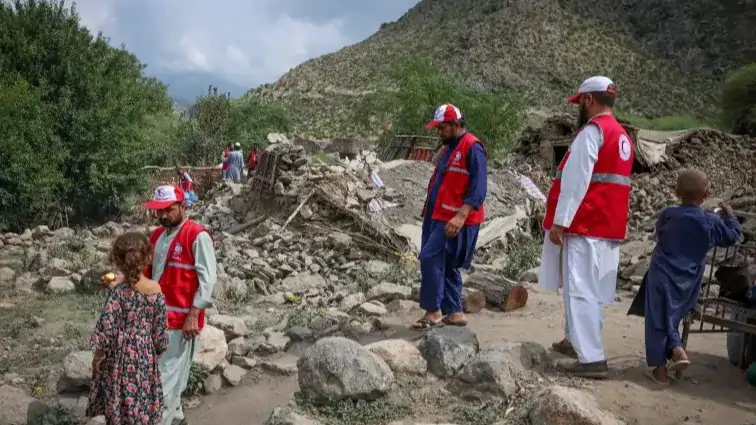
Devastating Afghanistan Earthquake Aftershocks Kill Thousands
Multiple Earthquakes Rock Eastern Afghanistan in September 2025
Afghanistan has been struck by a series of devastating earthquakes beginning on August 31, 2025, followed by multiple deadly aftershocks that have claimed thousands of lives and left entire communities in ruins. The earthquake disaster represents one of the deadliest natural catastrophes to hit the war-torn nation in recent decades, with the death toll continuing to rise as rescue operations struggle to reach remote mountainous areas.
Afghanistan Earthquake Sequence
Primary Earthquake – August 31, 2025
The catastrophic sequence began on August 31, 2025, at 23:47 local time (19:17 UTC) when a powerful magnitude 6.0 earthquake struck eastern Afghanistan. The epicenter was located approximately 27 kilometers northeast of Jalalabad, the capital of Nangarhar province, at a shallow depth of just 8-10 kilometers beneath the surface.
The region has been continuously battered by powerful aftershocks and additional earthquakes.
Catastrophic Death Toll and Injuries
The humanitarian impact has been staggering, with casualty figures continuing to climb as rescue teams reach previously inaccessible areas. According to Taliban government spokesman Hamdullah Fitrat, the confirmed death toll has reached 2,205 people, with at least 3,640 individuals injured. However, these numbers are expected to rise significantly as many remote villages remain unreachable.
The United Nations Office for the Coordination of Humanitarian Affairs (OCHA) reported that 1,368 people were confirmed dead and 2,180 others injured based on verified reports from 25 villages alone. The US Geological Survey initially estimated between 1,000 and 10,000 deaths were possible, with nearly 890,000 people exposed to very strong to violent shaking.
Widespread Destruction Across Multiple Provinces
Most Affected Areas
The earthquake devastation has been concentrated in four eastern provinces:
Kunar Province: The most severely impacted area, where entire districts have been obliterated
Nangarhar Province: Significant casualties and infrastructure damage near Jalalabad
Laghman Province: Substantial destruction in mountainous areas
Nuristan Province: Remote communities cut off by landslides
Infrastructure Damage
The earthquake sequence has caused unprecedented destruction:
Over 8,000 homes completely destroyed
6,700+ houses demolished according to authorities
98% of structures damaged in affected areas of Kunar Province
65% of buildings collapsed in the worst-hit districts
Entire villages such as Wadir, Shomash, Masud, and Areet were reportedly destroyed, with up to 90% of residents feared dead or injured in Wadir village alone.
Challenging Rescue and Relief Operations
Geographic and Weather Obstacles
Rescue efforts have been severely hampered by multiple factors:
Mountainous terrain making access extremely difficult
Landslides triggered by earthquakes and heavy rains blocking key roads
Remote locations requiring helicopter access to reach survivors
Continuous aftershocks disrupting rescue operations
Limited Resources and Funding Crisis
The Taliban government has allocated 100 million Afghan afghanis (US$1.5 million) for disaster response, but resources remain critically inadequate. International aid organizations are warning of a severe funding shortfall, with the World Food Programme stating it can only feed earthquake victims for a few more weeks before funding runs out.
International Humanitarian Response
United Nations Emergency Aid
The UN has mobilized significant resources:
$10 million released by UN aid coordination office (OCHA) for immediate response
Emergency mapping services activated through Copernicus satellite system
25 inter-agency assessment teams deployed to affected areas
Country-Specific Aid Contributions
Multiple nations have provided emergency assistance:
European Union: €1 million in humanitarian funding plus 130 tonnes of relief supplies via two humanitarian flights
India: 21 tonnes of relief materials airlifted, including blankets, tents, medical supplies, and water purification equipment
United Kingdom: Pledged £1 million ($1.3 million) in emergency aid
Canada: Providing humanitarian assistance through established partners
China: $7.04 million in emergency humanitarian aid through Red Cross Society
Geological Context and Future Risk
Afghanistan sits in a highly seismically active region where the Indian and Eurasian tectonic plates converge, making it particularly susceptible to powerful earthquakes. The Hindu Kush mountain range, where this earthquake occurred, experiences frequent seismic activity due to the collision and subduction of these massive geological formations.
The shallow depth of recent earthquakes (8-10 kilometers) has significantly amplified their destructive impact, as shallow earthquakes typically cause more intense surface shaking than deeper events. The region’s construction practices, with many homes built from mud, stone, and timber, have contributed to the high casualty rates and widespread structural collapse.